September is Lymphoma Awareness Month: time to dispose of weedkillers containing glyphosate (such as Roundup), which are known to cause non-Hodgkins lymphoma, and about healthier alternatives.
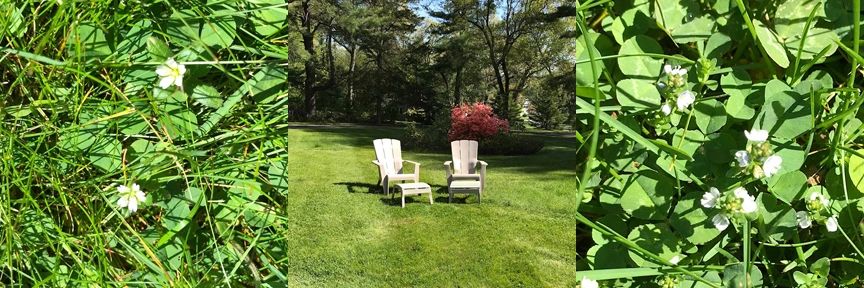
We stopped using herbicides and pesticides on our lawn over twenty years ago, and it is still green and lush. If you take a close look at our lawn, you will see Dandelions, Violets, Cinquefoil, Chickweed (left), Sweet Clover and Veronica (right) and more. Some of these “weeds” are highly nutritious and medicinal, and they represent the biodiversity that makes nature so resilient.
A lawn that grows onlyone species of plant, such as Bluegrass, is called a monoculture. It lacks diversity, and it is a wasteland for pollinators. It lacks nourishment – no flowers, no pollen and no nectar essential for sustaining wild bees, honey bees, butterflies and other pollinators. Furthermore, maintaining the perfect monoculture lawn requires the application of chemicals, including herbicides to eliminate all other plant life and pesticides to eliminate insect pests. These chemicals are harmful to pollinators, as well as pets and children. They also pollute groundwater and run off into streams and rivers, where they cause harm to fish, birds and other wildlife. So why use them?
If weeds truly bother you, try these safer alternatives solutions, presented by Drugwatch. I love my weeds, however, I will use mulch to keep them out of my garden beds.
Reduce yard labor, save money, and create a safe and healthy outdoor space for pets, kids, wildlife and you. Check out these Story Walking Radio Hour podcasts.
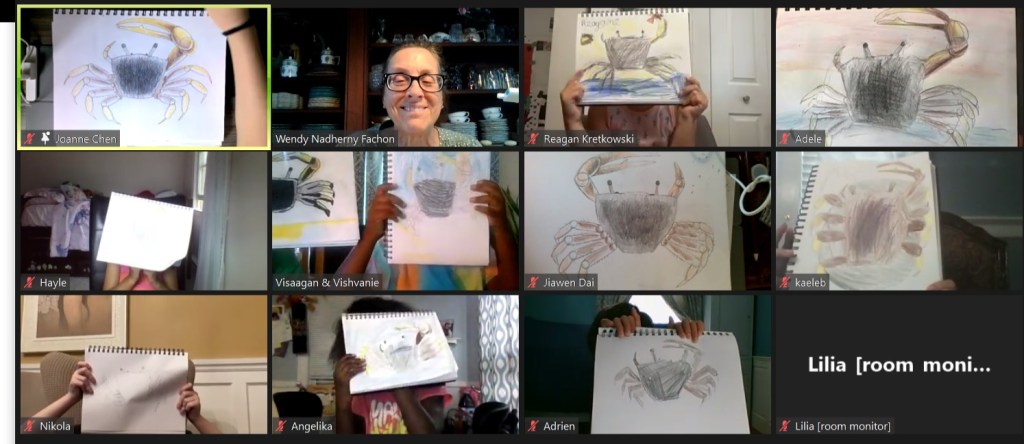
Yesterday, we taught kids “How to draw an Atlantic Marsh Fiddler Crab” (Week 5 of the Salt Marsh Nature Drawing series for grades 3-5). RISD student Joanne Chen led the drawing instruction, while I did the environmental science talk. We teach about animals classified as Species of Greatest Conservation Need (SGCN), so the kids can use their artwork to share the animal’s stories and help raise awareness.
I am always blown away by the final drawings! (screenshot)
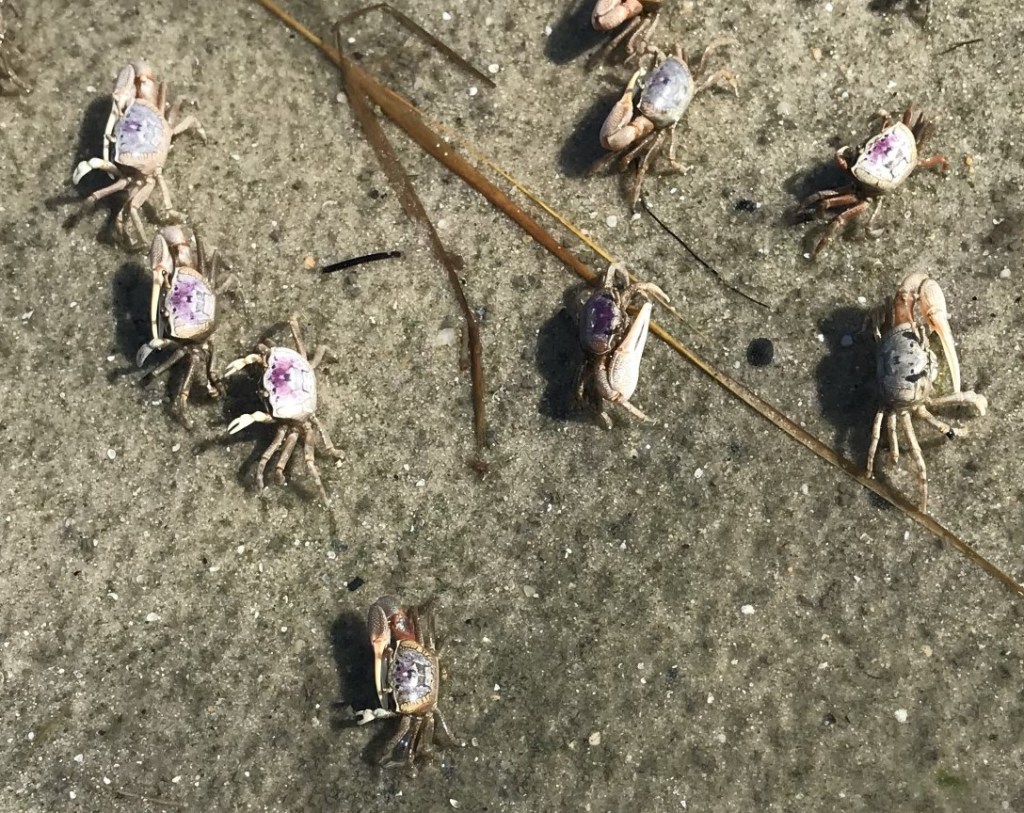
Fun fact: The common English name for “Fiddler Crab” (vs. Uca Pugnax) comes from the feeding habits of the males, where the movement of the small claw from the ground to its mouth resembles the motion of someone moving a bow across a fiddle (the large claw). Males fiddle to attract females to their burrows, but here’s the rub:
Water pollution! A fertilized female fiddler crab carries hundreds to thousands of eggs under her abdomen. She goes into the water and allows the eggs to hatch into microscopic free-swiming larvae, which live in the open water as part of the plankton. How does the water get polluted and what happens to these little babies?
Heavy metals such as mercury, copper and zinc (from manufacturing waste water) are toxic to larvae and cause developmental problems.
Pesticides runoff causes abnormalities and interferes with normal behavioral functions.
Chlorine, used as a disinfectant in water treatment plants, and then released into estuary waters, effects the growth and survival of fiddlers.
Loads of toxic laundry detergent chemicals find their way into estuary waters, too.
What can we do to help reduce the pollution?
Two days ago, I got phone call from my brother, Steve, asking if I saw the article he sent me about Why is laundry detergent is blue. Here is what I learned from that article: If your laundry detergent is blue (mine is NOT), it is time to change detergents. Laundry detergents are formulated with blue chemicals called optical brighteners to make clothes LOOK like they are brighter! To keep clothes looking bright, these chemicals have to stick like glue to the fibers of your garments, which means the chemicals are insoluble in water, which means they are not biodegradable. These harsh chemicals can cause rashes, hives and eczema, as clothing come in contact with skin. What doesn’t stick to the clothing ends up in the water, and scientists have found high volumes of optical brighteners in our water systems, and they believe these chemicals are causing mutations in marine life!
This article was written to promote Earth Breeze Laundry Detergent Eco Sheets, and Steve planned on ordering some and wanted my input. I did some additional research to see what chemical ingredients were infused into the Earth Breeze sheets. I saw the ingredient “fragrance,” which set off alarm bells in my head. More slight-of-hand marketing. Then I found a laundry sheet product comparison at Just Natural Home, which nixed Earth Breeze in favor of Clean People Laundry Sheets. I did some additional research to see what chemical ingredients were infused in the Clean People sheets. It is a completely different list of ingredients from Earth Breeze, and to be totally honest, I can barely pronounce the names of the chemical ingredients for either product, much less know what they are, how safe they are and whether or not they are truly effective at getting clothes clean and fresh smelling. One eco detergent I tried recently made my bath towels smell awful!
What I do know is that if we raise young people’s awareness of these issues, they will find better solutions. And I am heartened to know that more and more colleges are offering degrees in Green Chemistry. UMass Boston was the first school in the country to offer a Ph.D. in chemistry with a track in Green Chemistry. Read about The Greenest Colleges in Greater Boston and Rhode Island, and share the information with the teenagers in your life. Share the hot links in the article with your kids, see what you can learn together, and talk about it.
Time to stop fiddling around with Nature. It’s easy to see why fiddler crabs are an indicator of water quality and health in a wetlands system. I love watching the thousands of fiddler crabs that scurry up into the cord grass along the shore of the West Falmouth Harbor as the tide rises, and I hope to be able to enjoy the sight of them in the years to come.
This Thursday, the RI Senate Finance Committee will be hearing testimony for a allocating funds for farmland preservation. Rhode Island has the most expensive farmland in the country. Developers and their lawyers salivate over open land for affordable housing and solar farm projects, which guarantee them revenue and profit. How does this benefit us economically? Why do we need to preserve this land for farming? Here’s the written testimony I submitted this morning. Please read and consider sending in your own testimony. Let’s flood the state house with letters!
Date: Monday, May 23, 2023
To: Chairman Louis DiPalma, Senate Finance Committee
cc: Representative Michelle McGaw
From: Wendy Fachon, East Greenwich
RE: Support for S560: $5M for the Preservation, Protection and Conservation of Farmlands
Dear Chairman DiPalma,
I live in East Greenwich and am testifying in support for House Bill 6018 and Senate Bill 560, funding farmland conservation in the Governor’s FY 24 budget. Thank you bringing this issue to the attention of your committee, My husband I have been supporting farmland conservation through our weekly purchases at local farms and farmer markets, because the food quality and nutrition is better than store-bought produce that is grown and transported from afar.
When I do go food shopping at a supermarket, I notice that most of the produce is labeled as coming from California or south of the border. Between the breakdown of the food supply chain during the pandemic and California’s worsening climate and water challenges, it is time for Rhode Island to focus on food security for its citizens.
We recognize and appreciate the many quantifiable advantages, beyond food quality, of a local farm economy, because it…
keeps Rhode Island dollars circulating locally
provides over 2,500 “green economy” jobs and over $250 million in revenue
improves food security for all Rhode Island residents
eliminates fuel costs and carbon emissions that result from long distance transportation
attracts matching funds from federal and philanthropic resources
harbors the potential to grow exponentially, resulting in an abundance that can be exported out-of-state
helps achieve climate resiliency and soil fertility, through use of regenerative practices
assures fresher, better tasting food and less spoilage
generates agro-tourism dollars
builds our sense of community and pride
As you know, Rhode Island has the most expensive farmland in the country, making it difficult to grow the local farm economy. And yet, farmland preservation is a good long-term investment that will appeal to voters. I am among the many asking you to include $5 million in the budget to support the Agricultural Land Preservation Commission, which is critical to preserving important RI farmland.
Thank you, Chairman DiPalma and Finance Committee members, for your service and for listening. Please, help pull S560 through the budget allocation process, so $5 million (or more) can go towards farmland preservation in the Governor’s FY ‘24 Budget. Lead us forward.
Thank you!
Wendy Fachon
East Greenwich, RI
Submit to senatefinance@rilegislature.gov and copy your local senator and house representative on your correspondence. Go here for the email addresses.
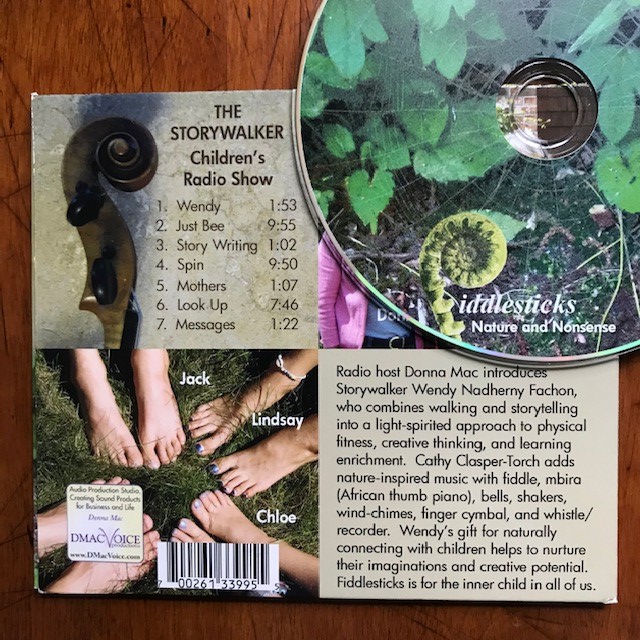
My fascination with fiddleheads and ferns began around the time I was creating my Fiddlesticks story CD, which is about slowing down and taking time to see and appreciate God’s creative work through nature. Learn more about the CD here. Now, as I consider options for shade-tolerant plants to include in the ground cover layer of our food forest garden, I have been taking time to research ferns more extensively. Here is what I now know:
A few fern species are edible during their fiddlehead stage, however, most species are toxic. Fiddleheads are the tightly coiled tender green tips that unfurl in the spring to become fern fronds. Fiddleheads are so named because they resemble the scrolled end of fiddle or violin. The time for foraging them is brief. Wait too long, and the fiddleheads will have already opened into the feathery fronds of mature ferns, and they will be inedible. As ferns mature, they become more toxic.
The fiddleheads of the Ostrich Fern, Matteuccia struthiopteris, are edible. Their bright green coils are covered with thin, brown, papery scales, which will fall away as the frond unfurls. Ostrich Ferns are also distinguished by a deep U-shaped groove in the inside stem. Ostrich Fern fiddleheads should be well-rinsed with cold water and fully cooked before adding them to salads and other dishes. In fact, it is best to blanch fiddleheads in boiled water even before sautéing or cooking in other preparations.
Ostrich Fern fiddleheads are prized for their crunchy texture and delicate flavor, which is somewhere in the range of asparagus, broccoli and spinach. Nutritionally, fiddleheads contain omega-3 and omega-6 fatty acids, vitamin A, vitamin C, potassium, iron, manganese and copper.
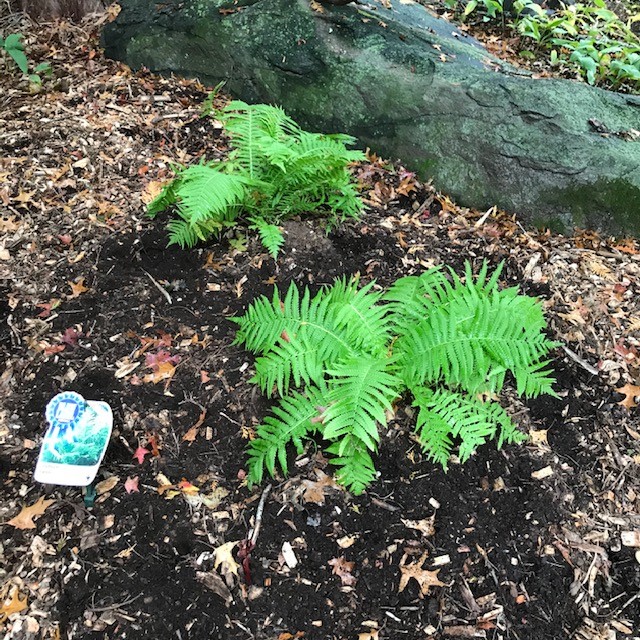
I started a small fern nursery, with specimens I should be able to propagate and transplant to other areas of our property. Propagation is the process of using one or more plants make more plants of its kind. To establish the nursery, I sheet mulched a shady area outside our kitchen window, and I splurged on the purchase of two mature Ostrich Ferns at a local garden center.
The ferns beautify the area, however, there was still a lot of empty space around them, and my husband suggested buying and planting five more. I would love to, however, it would be more costly. Instead, I have chosen to be patient; I will wait and order some ferns online in the early spring. bThose plants will be smaller and less developed, but far less costly.
Alternatively, I could be even more patient and wait for my two ferns to self-propagate naturally. Ferns self-propagate in two ways. They can propagate sexually by reproducing and scattering spores. Not seeds, but spores. For a gardener to create the right conditions for fern spores to germinate and develop into a new fern takes a lot of patience and care. This is, however, the best way to propagate large numbers of new ferns.
Ferns can also propagate asexually, also known as vegetative propagation. Most ferns, after they grow from spores, will begin to spread by means of their creeping rhizomes, the root system that spreads underground. Over time one plant can grow into a colony. For gardeners, vegetative propagation is as easy as physically dividing a fern pant in half, carefully separating clumps of roots and replanting them. This method is easier than growing ferns from spores. Unlike with spore propagation, each new plant will be a clone, genetically identical to the original plant.
Through the vegetative method, gardeners can speed along the propagation of many perennial species. Berry plants can be propagated by cutting shoots and treating them to grow roots. By learning vegetative propagation skills, gardeners can dramatically increase their food forest abundance.
I have plenty of time to experiment with fern propagation, since fruit trees will require some years to grow. The trees will need to grow big enough to be able to produce sufficient shade and moisture to support a flourishing ground cover of ferns.
Two weeks ago, I walked the property of a local fruit grower, Narrow Lane Orchard, which is a family-owned farm. I have been buying Narrow Lane Orchard fruit at my local farmer’s market for a few years now, and finally took the time to go visit the orchard, which is only five miles away from our house. It has taken me far too long to get around to doing this.
About this orchard… back in 2004 Stephen and Sharon Grenier purchased Narrow Lane Orchard to save the 30 acre farm from being developed into residential homes. Expanding the farm’s diversity of trees, shrubs and vines, the Greniers have grown more than 20 varieties of apples, peaches, nectarines, blackberries, blueberries and kiwi berries.
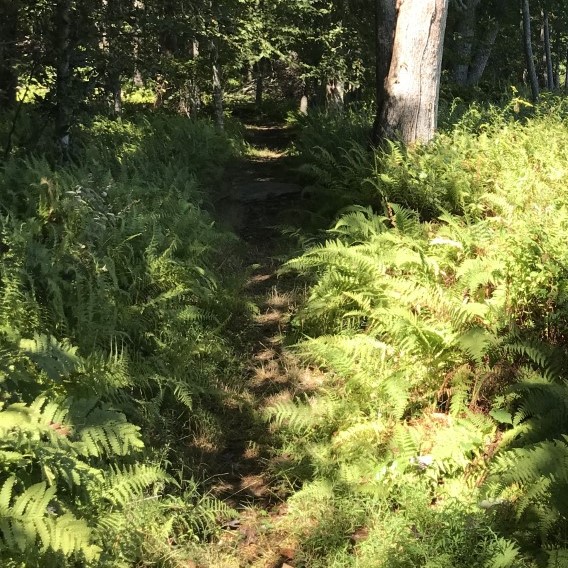
The orchard itself is surrounded by 8-foot tall deer fencing to protect the trees. Visitors enter the orchard through a gate situated next to the orchard’s farm stand. My favorite feature of the farm is the one-mile Nature Trail that winds around through the woods surrounding the orchard and outside the fencing. Here I saw lush green ferns growing everywhere. I have never seen so many ferns in all my life. I felt as if I was walking through a prehistoric forest. This landscape was a clear testament to the fern’s ability to self-propagate, and it was an indication that I could indeed grow ferns beneath the tree canopy on our property.
While researching ferns, I discovered they are one of the oldest groups of plants on Earth, with a fossil record dating back almost 400 million years. Back in the time of the dinosaurs, ferns were actually the main food source for the herbivorous sauropods, the largest animals ever to walk the earth. Ferns also played a vital role in plant evolution, specifically in the development of vascular tissue. Without the development of plant vascular tissue, we would not have berry bushes and fruit trees.
The fern category of plants, due to its long-lived presence on earth, is highly diverse, having evolved into the 10,500 living species that inhabit the earth today. Ferns tend to grow in moist, shady areas among the trees of the forest, which provide the ferns with protection from wind, over exposure to sunlight, and excess heat from the sun. Some species, however, can grow in desert climates.
Within a forest community, ferns have their own important ecological roles. They provide shelter, shade and food to small animals. Bracken ferns are eaten in the fiddlehead stage in the springtime by white-tailed deer and eastern cottontail rabbits with little consequence. As these fern grows into adults, however, their fronds begin to produce toxins, and they become unpalatable. At the same time, insects like grasshoppers and snails can eat adult ferns on a regular basis, despite the increased toxicity. Generally, plants produce toxins as a defensive measure, so they can grow and propagate.
One final fern fact, that bares further research, is their ability to uptake heavy metals from the soil. They can be planted to heal contaminated environments. I think that’s very cool!
Back on July 1, I began cutting down the ornamental shrubs in the center of the front yard to clear the space and replant it with something ornamental and edible – sweet cherry, mulberry and fig trees. Many years ago, the area had been planted with an azalea, two rhododendrons and some yews. The rhododendrons had been slowly dying, and the yews had been devoured by grazing deer. Wild raspberries, brambles, and a large tuft of ornamental grass were beginning to overtake the area, while two black cherries saplings and three white pine sprouts had taken root among the yews. I removed the black cherry and white pine first. Then as I cut away the yew and azalea branches, I found a hidden treasure – two mulberry saplings.
My food forest design specified planting a mulberry tree near this very spot, so the discovery of mulberry already growing here was magical. And, I found not just one mulberry tree, but two. I dug the smaller mulberry sapling out by the roots and transplanted it in the center the back wood lot. The larger mulberry sapling was entangled with the azalea roots, and I left it undisturbed.
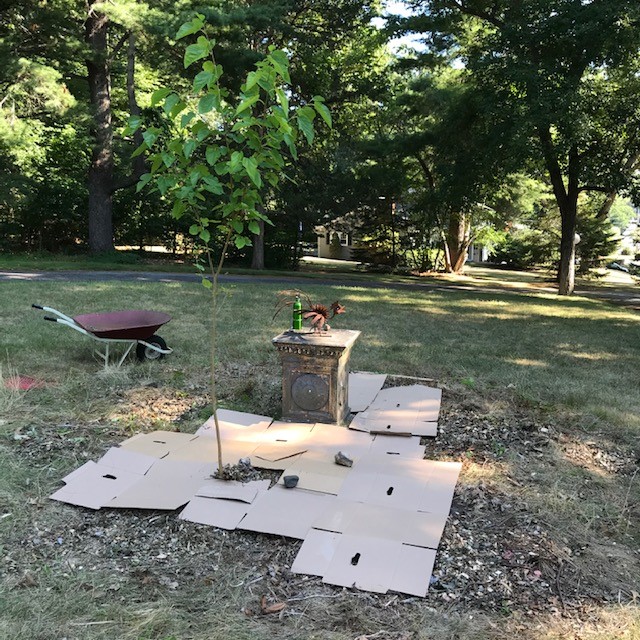
This morning, August 4, I began to do some sheet mulching ’round the mulberry bush.’ I started work early, while the front yard was still in shade. The first step in this process was to lay down sheets of cardboard and place newsprint under the gaps and holes. I soaked the layer with a garden hose. This layer will prevent the grass, brambles and weeds from growing back, so we can replant with berry bushes, herbs and clover.
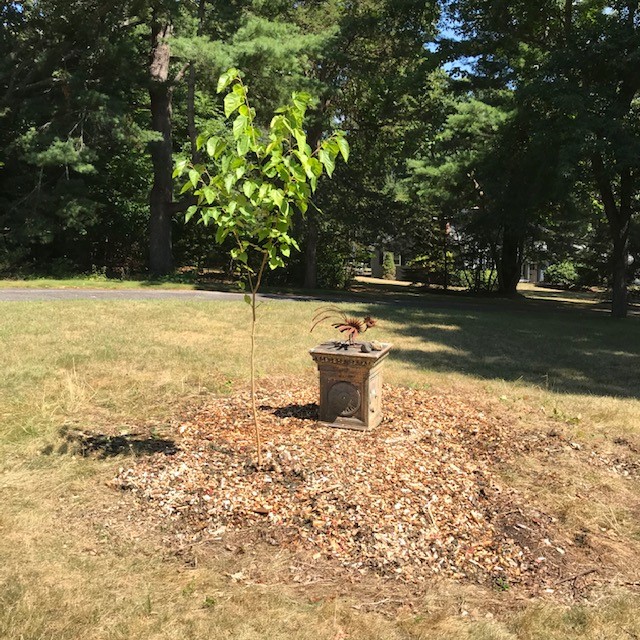
Then I added a layer of wood chips. When the Largess Forestry tree crew removed the invasive Norway Maple trees in the back wood lot, they left me a generous pile of wood chips. I had completed sheet mulching this small area by 11 am. The shade was gone, the sun was beating down, and I was coated with grime and sweat. I was done for the day and ready for a cold shower. Please with the transformation of the center of the front yard, I put away my garden tools and headed indoors.
As I collect more cardboard, I will continue to layer outward from here. Then in the late fall, the area will be ready for planting cherry, fig and other fruit trees, to keep the magic mulberry company.
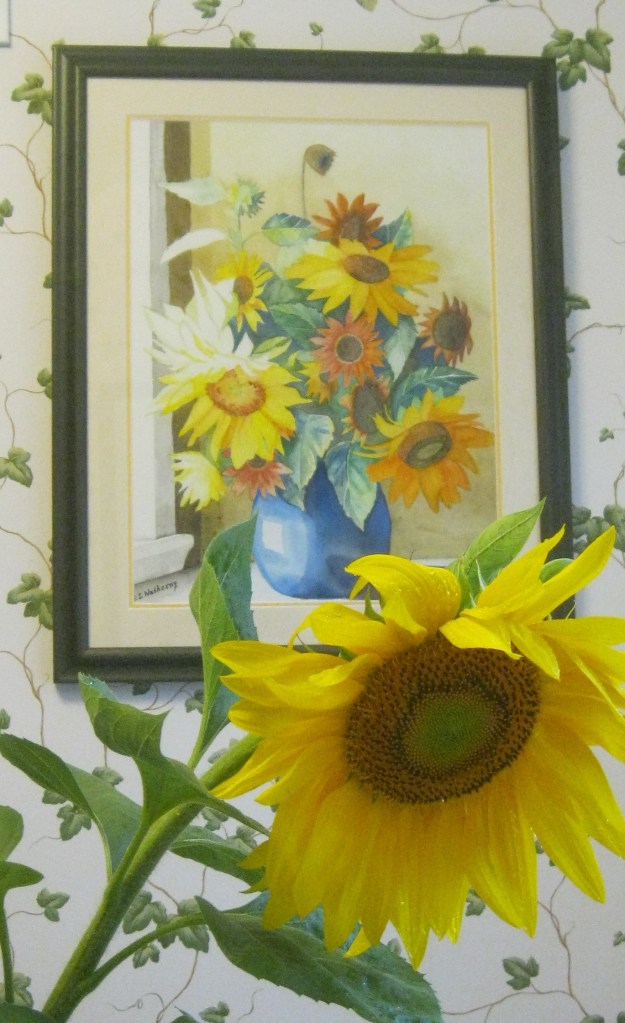
Every morning when I eat breakfast, I look at a favorite watercolor rendering of sunflowers on the wall, across from where I sit. It was painted by my Mom. She was gifted. She loved flowers, she loved art, and she loved to create…
When we were kids and took family vacations, one of my favorite memories was when Mom would lead my sister, Sandy, and I in search of wildflowers. We would thumb through her field guide to identify the plant by its common name. Then we would place a sample of the flower inside the book to press it flat and save it. We would find Indian Paintbrush, Monkshood, Butter and Eggs, Queen Anne’s Lace and Black-Eyed Susan. We were enchanted by the names of the flowers, their striking colors and their amazing shapes. After the flowers dried inside the field guide, we would make wildflower art by arranging the flattened flowers on a piece of paper and glue them into place.
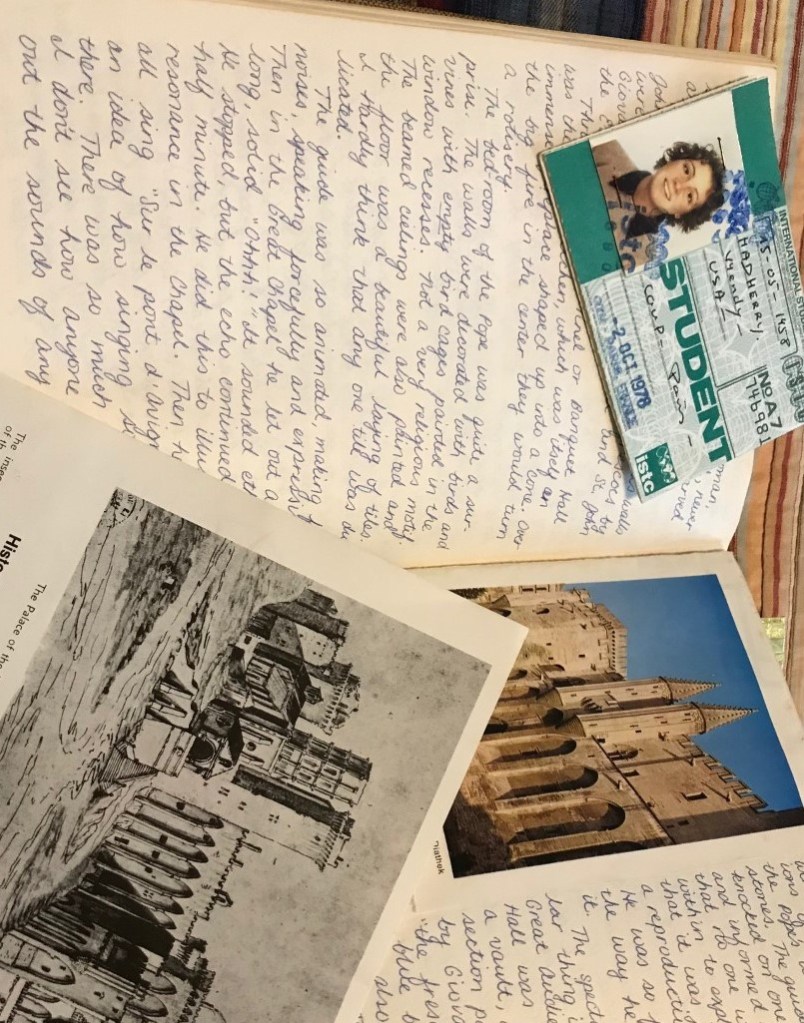
Another wonderful memory was traveling the south coast of France with Mom. Just the two of us. I had been studying in Paris, and she flew over after I completed my studies. Our adventure began in her hotel room in Paris. We poured through her travel guides, while we drank wine, nibbled on cheese and apples, and scattered baguette crumbs all over her bedspread. We made our plans, deciding which towns, which museums and which hotels, and we and planned a Eurail trip that would take us from Paris to Avignon, Carcassone and Marseilles. This was Mom’s first trip abroad, ever. The first of many trips, as she began traveling the world with Dad, shortly after this. She loved experiencing new cultures…
When Mom and Dad built their dream house in Florida, Mom dedicated one room to serve as her office and art studio. She spent many happy hours there, playing with her brushes and acrylic paints. She found inspiration from her travels, books and museums, and she loved playing with color to create all different kinds of landscapes. When I was visiting, she would invite me to view a work-in-process with a critical eye, and would welcome suggestions. She painted pictures for her own homes, and sometimes she painted for family and friends… which brings me back to the Sunflower painting on the wall. Thank you, Mom for the many, many ways through which you enriched our lives!
My mother, Elinor Nadherny, passed away last November at the age of 92. I continue to be blessed by her love and influence.
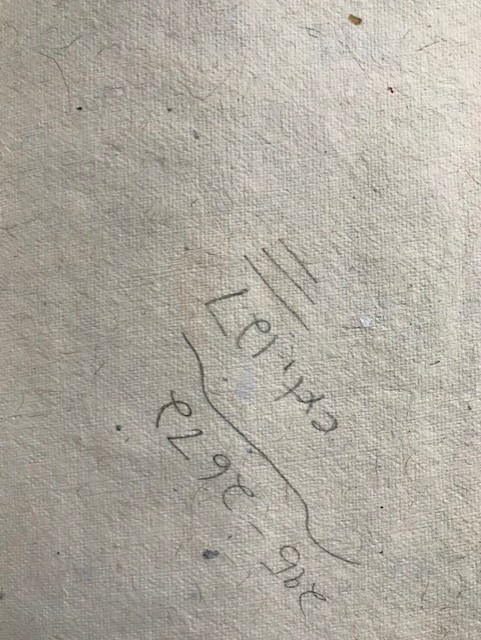
Turning to the next page I found a phone number, written upside down and at an awkward angle across the page. The phone number ended with an extension… 127… which was underlined… three times.
I turned the page again and found a silly poem.
The poem was surrounded with samples of a person’s signature… Emily something… written several times, the way someone practices a signature with the last name of a schoolgirl’s crush. One of the signatures at the top of the page had a halo drawn over the E.
The rest of the journal’s pages were blank… just waiting to be filled. Upon returning home, I went into our study, where one entire wall is bookshelves, floor to ceiling. An overflow of books laid in scattered piles across the floor in front of the shelves. From another shelf on the opposite side of the room I pulled out a reference book titled Angel Numbers 101, because I wanted to look up the meaning of underlined number – 127. The number 127 means “You’re on the right path… stay positive and keep doing what you are doing.”
I studied the signatures more and determined that Emily’s last name was Martin. Emily Martin. On a whim, I googled Emily Martin, which took me to emilymartin.com and a page about a book exhibit that had just opened in San Francisco (2012). The exhibit, mysteriously titled “Exploding the Codex,” was about books and storytelling. I read:
“These books go beyond the traditional format to unveil new ways of presenting and telling stories. Often theatrical or stage-like in their presentation, they pull the viewer into their individual dramas and diverse varieties of form and presentation. The exhibition explores the ways in which a book’s size and dimensions determine our relationship to it and what it is trying to tell us. One can choose between the intimacy of a tiny journal, private and curious, easily hidden as if keeping a secret between reader and teller…”
In that moment of reading, I imagined myself an actress, standing on a stage, surrounded by bookshelves, and holding a mysterious journal in my hand – a secret codex – and I was being pulled into storytelling of the most unconventional nature. Of course, it was all symbolic, and it was a powerful message.
And so, I share this message now, because I believe it is meant for all of us. We each author our own life narratives through our responses to our personal situations… our thoughts… our words… and our choices of action. Life is filled with mystery, and uncertainty, which often requires us to be patient as things continue to play out, and it requires us to respond creatively and positively. “We won’t be askew.” Smile and stay positive.
For tools to help you author your own life narrative go to this page.
True story. I found a leather-bound journal, standing upright in the middle of the road. I felt as if it had been standing there waiting for me. The leather was a deep burgundy red color and the cover was stamped with the symbol representing the “third eye.”
The third eye is
one of the seven chakras, or spiritual energy points,
associated with the pineal gland, which sits in the middle of the brain, behind the forehead,
sometimes described as the mind’s eye, the powerful eye of one’s imagination and creative consciousness,
also referred to as the “knowing” eye of intuition, the source of psychic ability.
Opening the journal, I found the imprint of a lipstick kiss on the inside cover. A mouth, ready to speak its secrets.
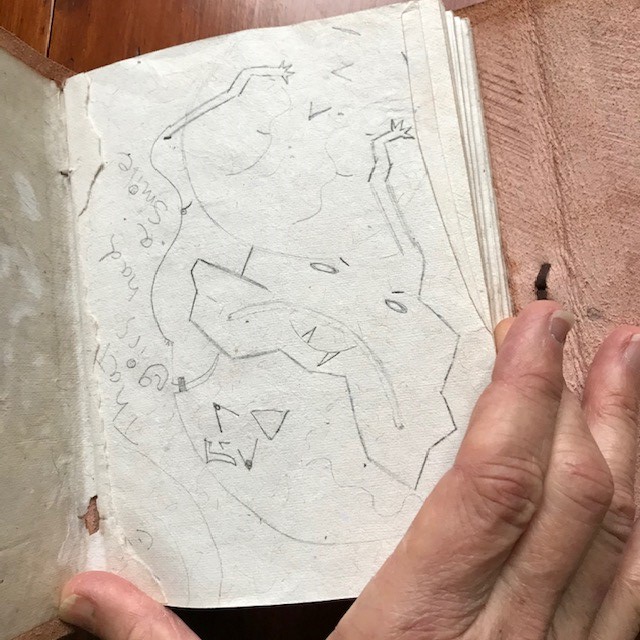
The first page had been torn out of the book, however, on the next page was an abstract drawing of strange faces and creatures. The drawing was simple, yet expressive, making it open to interpretation.
How would you interpret this drawing? What does it mean to you? Is it telling a story? Tap three times on your forehead to wake up your third eye, look at this picture, and write down what you see, think, and feel.Leave a reply to this creative challenge at the bottom of this page. Have fun with this exercise!
Read about what else I found in this journal here.
chakras: (yoga word) the seven centers of spiritual power in the human body
pineal gland: a tiny cone-shaped organ in the center of the brain that was important to philosopher René Descartes’ (1596–1650). He regarded it as the principal seat of the soul and the place in which all our thoughts are formed. Today, we know it functions primarily as a gland secreting melatonin, the “sleep hormone.”
philosophy: the study of the nature of knowing, being and reality
intuition: a natural power to know something without any proof;a feeling that guides a person to act a certain way without fully understanding why
interpretation: the action of explaining the meaning of something
From the last chapter, titled Final Words, in THE DIFFERENCE MAKER:
“Mom, when I passed, you went to the aspect of life that feels hopeless… you allowed yourself to experience that and let go of everything and say…
“’I’m not going to do a damned thing. I’m going to embrace what this hopelessness is, because I can’t jump past it and pretend it’s okay. It’s not okay. There is a side of life that is absolutely hopeless, and, God, you have to show up for us in that hopelessness, and I’m here in that hopelessness, wanting you to show up with me and for me, because humanity needs you to show up in that place of hopelessness now, because that seems to be running the show. That seems to be the all-pervasive power here, and we’re not going along with it anymore. We can’t, please help me. Show me. Help me to experience the transcendence that we can [back] to life, from that place of hopelessness, because so much of the world is in that hopelessness.
“‘So, I’m here. I know what it feels like. I’m relating to them. It feels like ‘Why do anything? It doesn’t matter.’ Why transcend when you take two steps and you’re knocked back down. Or why birth a child into existence only to have to let go of them and not be able to see them fulfill their life? Why come here with all this brilliance and transcendence, and yet what controls this world wants to suppress it and rip it apart… and cover it and make evil appear like the way to go… and when does it change? When does it actually change? When do we get to see the results?’
“And so it’s perfect, because in the extreme polarity, when it seems like we’re already headed for extinction, [there’s an] agreement to reemerge from your own divine authority, except that God is reminding you that you will never be alone… now imparting [this] at an accelerated rate… many on earth are not from the original blueprint of God… message will reach those from the true organic source Mother Father God… moving into the vibration of love… God spark God power within them… restore… move through inertia to the other side of this suffering… even in helplessness, all humanity will be fulfilled in their destinies in this time of great change. God is present in all hearts, needs no intercession… Realm of Cause…”
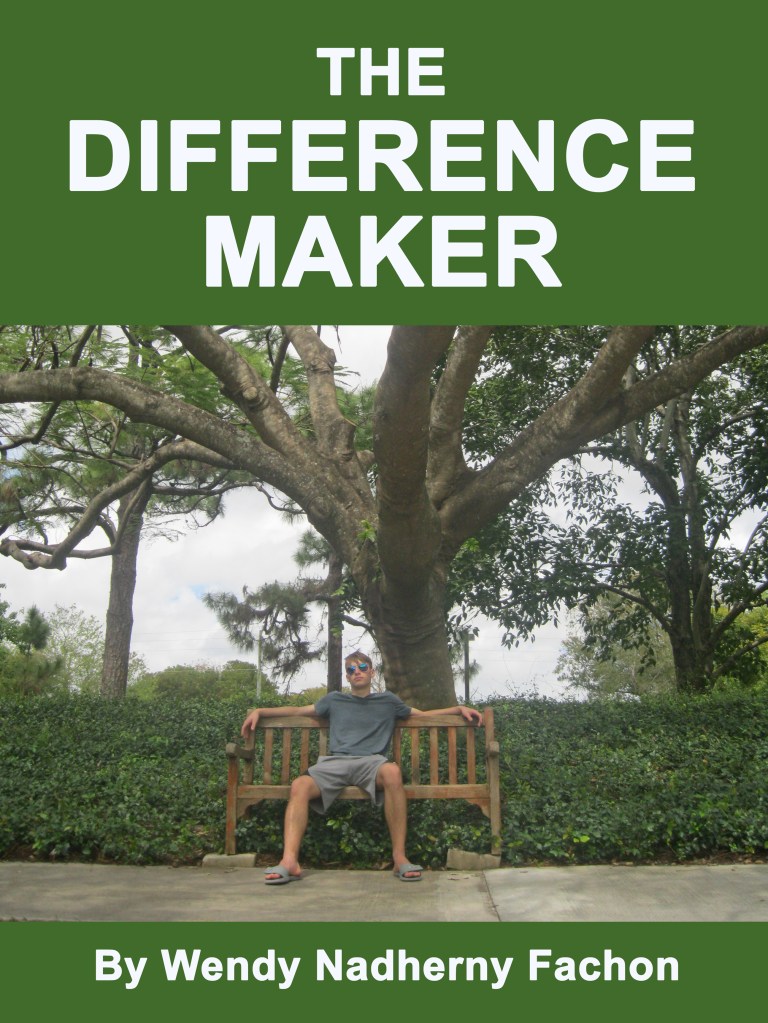
I received this message 1-1/2 years before the pandemic began and was prompted to start writing a book for young people. The worries my son, Neil, faced five years ago – environmental, social and health challenges – have intensified for many of today’s youth, yet the lessons Neil left behind are all the more relevant. THE DIFFERENCE MAKER is a collection of stories written to help guide young people through a world of suffering to where they can step into their own great power. While the journey requires faith, courage and perseverance, the rewards are purpose, fulfillment and a realization of the highest form of love. I urge young people “to claim your inner wisdom and strength, to remember to view your life as a story with a higher purpose, and to take a conscious hand in writing that story.“
Today is Neil’s 24th Birthday, and I imagine he is celebrating up among the stars. 20 years ago, after visiting the Kennedy Space Center at Cape Canaveral, we celebrated Neil’s birthday with an astronaut theme, unaware that 15 years later he would become a Cancer Moonshot kid… diagnosed with DIPG.
In 1962, when I was four years old, astronaut Neil Armstrong’s 3-year-old daughter, Karen “Muffy,” died of DIPG. How is it that in 1969, we could put a man on the moon (Neil Armstrong), and yet, over fifty years later we are still unable to save a child from dying of pediatric brain cancers like DIPG? Fifty years later, oncologists are still targeting tumors with radiation and without improving outcomes.
In January 2017, Vice President Joe Biden announced the Cancer Moonshot campaign to increase resources for cancer research and improve coordination across the research community. March 4, 2017, we attended Neil, 19, as he met with an oncologist to view MRI images, receive his diagnosis of DIPG and an estimate of three months life expectancy… unless he decided to undergo 30 days of radiation, in which case, he might have six months of life expectancy. We were told there was no cure. There were, however, clinical trials studying new drugs and procedures for DIPG treatment, and we were told to start doing our own research into these options.
Neil declined radiation, and we quickly set about to doing the research. At age 19, Neil was too old to qualify for many pediatric studies and too young for adult studies. We discovered an FDA-approved Phase II clinical trial opening in April. It was located in Houston, home of the Johnson Space Center. We had to dig through an inordinate amount of negative media, about the researcher and his protocol, in search of the truth. Neil skyped with a 29-year-old DIPG survivor of five years, who had used this therapy and been cured of something for which there was no known cure. Neil based his decision on information gathered from books, research results published in medical journals, documentaries, personal conversations and the following simple facts:
The antineoplaston treatment the survivor spoke of was non-toxic, and it worked for her after all standard protocols had failed her.
The DIPG clinical trial was the only trial that did not require prior radiation and was open to all age cohorts.
The treatment sought to address an underlying systemic deficiency – the absence of an essential peptide in cancer patients, which is produced in the bodies of healthy people, as detected in both blood and urine.
Neil was the first patient to enroll in the new DIPG Phase II trial at the Burzynski Clinic, involving the administration of antineoplaston formulations A10 and AS2-1. The day he began his infusions, however, Dr. Burzynski received a letter from the FDA announcing suspension of the trial. We sat with Neil, as he reviewed the letter and related documents with the doctor. A highly accomplished chess player and science student, Neil quickly saw this as a false move in an ongoing high stakes chess game that the agency had been playing with this particular doctor for many years. While the U.S. government was launching its Cancer Moonshot campaign, the agency was going to control who could participate and who could not. Many barriers were placed between Neil and his dream of a pursuing a cure. He knew there was no guarantee, however, he strongly believed in his freedom to choose for himself and his Right to Try what he thought would give him the best chance for survival. As a cancer patient given three months to live, he fought hard for his life on numerous fronts, and he overcame great odds to survive for almost a year, without radiation treatment.
For over fifty years, billions of dollars have been spent searching for a cure for cancer. It is a huge money-making scheme for the industry players. My hope is that we will dedicate dollars to idetify and correct the underlying causes – peptide deficiencies, vitamin and mineral deficiencies, toxic chemicals and metals deposited in tissues (from tap water additives, herbicides and vaccines), leaky gut and gastro-intestinal biome imbalances, etc. Perhaps the answers are not up among the stars. Perhaps they are down here at Ground Zero.
May 17 is DIPG Awareness Day, and the DIPG community is working hard to make this a national resolution. Join us on the “DIPG Advocacy Group” on fb #moonshot4kids.







 Wendy Nadherny Fachon