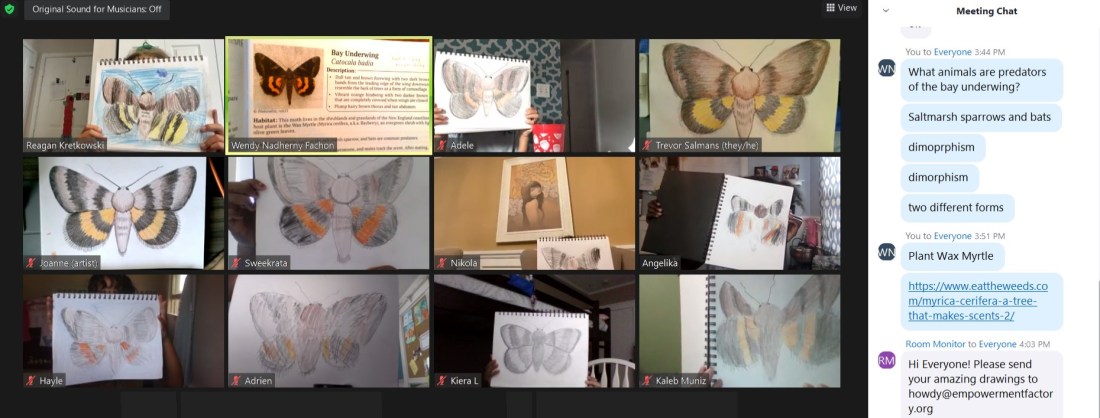
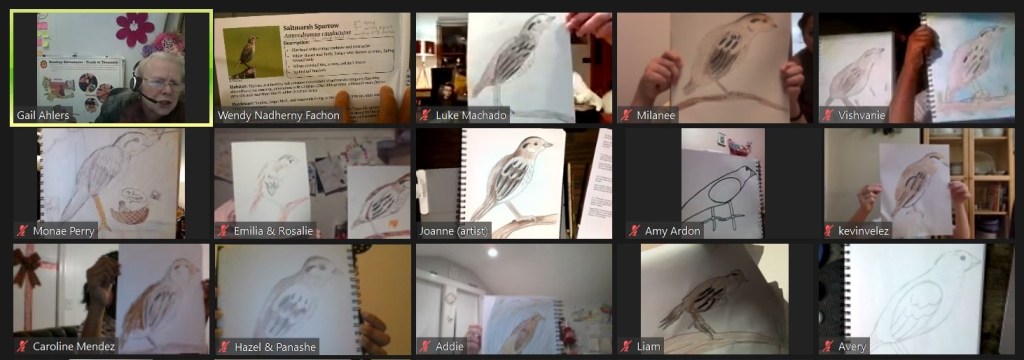
Students share their work at the end of the 11/27/23 Nature Drawing workshop, led by Gail Ahlers, Joanne Chen and myself.
While the Saltmarsh Sparrow (Ammodramus caudacutus) has been named the poster child for sea level rise, its actual story is about restoring salt marsh habitat and conserving a threatened species, protecting it from loss and harm. The Saltmarsh Sparrow is the first of seven species studied in the Empowerment Factory’s Nature Drawing Salt Marsh series, which begins with establishing an understanding of the value of a salt marsh.
SALT MARSH HABITAT
- Rhode Island salt marshes are found all around the Narragansett Bay – along the shores of salt ponds, in small bays and estuaries, and within estuary rivers.
- Salt marshes serve as natural pollution treatment systems by filtering out pollutants before they reach coastal waters. The marsh’s diversity of plants and shellfish help with the filtering.
- Salt marshes provide coastal community developments with a protective buffer during storms and flooding, however, human development itself has increased the likelihood of floods occurring.
- Salt marshes provide nursery grounds and foraging habitat for hundreds of species of birds, fish, shellfish, mammals and other animals. At the same time, salt marshes provide recreational areas for line fishing and shellfishing, practices which need to be managed to prevent overfishing.
The salt marsh is a vital resource for both wildlife and humans. Unfortunately, this habitat has been destroyed by human activities, which have thrown the ecology out of balance and adversely affected the wild inhabitants in different ways. The City of Providence was once known as the Great Salt Cove. Over the past 200 years, however, humans have filled an estimated 60% of Rhode Island’s salt marsh’s with mud and sand. Construction of dikes, roads and rail crossings have restricted natural tidal flow and disrupted numerous marsh ecosystems.
The Saltmarsh Sparrow has been living life on the edge of danger and destruction, literally, because they tend to build their nests just above the “normal” high tide mark. Like humans, they love their waterfront property. Each female has 26 days, within the 28-day high tide cycles of the full moon, to build her nest, lay her eggs, hatch her chicks and feed them into fledgling stage. All this has to happen within 26 days! What a Super Mom! This adaptation has been necessary for each baby bird’s survival, yet increasingly marshes are flooding before peak tides and again at mid-cycle, destroying many nests.
How does this happen? It all comes down to the science of hydrology, the exactness of how a salt marsh is flooded by the tide and how freely ocean water is able to move in and out of the marsh area. Specialized plants and animals have adapted to survive in particular areas of the marsh, and this defines the entire marsh food web and complex ecosystem.
Solutions to correct this situation include the repairing stone culverts that have collapsed and restricted the flow of water under elevated roadbeds, digging shallow ditches to help drain areas, removing substrate to elevate land mass and replanting areas with salt marsh grasses. These are all important jobs for humans to take on.
While studying and drawing a different animal each week, students learn about its habits and the problems challenging the survival of its population. Each species has a different story to tell. Students use their artwork to share these stories, build awareness and advocate for species and habitat conservation.
LEARNING OBJECTIVES AND MEASUREMENT BENCHMARKS
Increase in environmental literacy: Students take a pre-survey and a post-survey to assess their acquisition of new knowledge.
Mastery of drawing skills: Students demonstrate their skill development through the completion of seven sequential drawing projects.
Social and emotional advancement: Teachers observe the students as they present themselves on-screen, noticing improvements in mood, social comfort within the group, discussion participation, self-expression and overall self-confidence.
Salt Marsh Nature Drawing is the fifth course in the Nature Drawing series created and taught by The Empowerment Factory. Developed in partnership with the RI Department of Environmental Management, the bilingual teaching materials support the lesson structure in presenting the salt marsh habitat and seven Species of Greatest Conservation Need (SGCN) living there:
Saltmarsh Sparrow Ammodramus caudacutus
Bay Underwing Catocala badia
Northern Diamondback Terrapin Malaclemys terrapin terrapin
Bay Scallop Argopecten irradians
Atlantic Marsh Fiddler Crab Uca pugnax
Striped Kilifish Fundulus majalis
Atlantic Brant Branta bernicla
Almost all Nature Drawing courses are taught virtually, and the format has been highly successful in terms of attendance, student engagement and project quality and completion. While this course meets Next Generation Science Standards (NGSS), Common Core State Standards (CCSS) and Social Emotional Learning Standards (SEL), it places an emphasis on critical environmental science learning.
Contact The Empowerment Factory about bringing Nature Drawing into your school or classroom: theempowermentfactory.org, howdy@empowermentfactory.org, 401-365-1010.
 Wendy Nadherny Fachon