For Our Children (Part 2): Parents Leading Civic Engagement

Over the past five years, the Story Walking Radio Hour (SWRH) has introduced podcast listeners to some amazing parents and their difference making efforts. As 50 percent of children in the U.S are now afflicted with chronic health issues, parents are taking action to reverse this trend. When parents discover their own children’s lives being threatened by environmental toxins, they become compelled to learn more and correct the situation, for the love of their children and children all across the country.

Zen Honeycutt, a podcast guest as founder of Moms Across America, advocates for healthy community food systems and promotes organic whole food, free from pesticides, herbicides and other contaminants. She has presented astonishing lab analysis of baby formula and fast food that tested positive for heavy metal contamination and continues to conduct similar studies. She has been gathering and publishing solid evidence. Honeycutt is the author of Unstoppable: Transforming Sickness and Struggle into Triumph, Empowerment and a Celebration of Community.

Rachael McIntosh, founder of the Foundation for Bioethcis in Technology, has spoken on two episode. She cares deeply about the historic shift of life on Earth caused by technological advances — specifically synthetic biology introduced into the natural world and even into humans. She is a community organizer known for her advocacy work crafting legislation for the regulation of toxic atmospheric emissions. Few people are aware of the heavy metal particulates being sprayed into the stratosphere for alleged purposes of weather and climate modification. These particulates shower down to pollute the air, water and soil. McIntosh has presented compelling lab analysis of rainwater with high levels of aluminum, barium and other toxic metals. Rachael brings attention to other advanced technologies through monthly news releases and presentations. She is the author of the fictional Security through Absurdity series of books, in which she combines her personal experiences with scientific fact into a compelling narrative that explores bioethics.

Cecelia Doucette, founder of Massachusetts for Safe Technology, is a three-time guest on SWRH. As a communications expert, educator and community organizer, Cece works at the local and state level advocating for tech safe schools, homes, businesses and for regulation of wireless technology. She provides tools, education and informational resources to help people identify, mitigate and eliminate the health effects of living within the radioactive frequencies of cell phones, cell towers, wifi, Bluetooth and smart meters. She introduced listeners to the Safe Living Technologies RF meter, which allows anyone to measure electromagnetic frequencies in any environment. Paired with the monitoring of physical symptoms, these meters can help prove evidence of harm from electromagnetic radiation (EMF) exposure. She works with legislators to craft legislation and leads citizens in advocacy.

Janet Demeter, who lost a child to DIPG brain stem cancer, is the founder of Jack’s Angels Foundation, host of Childhood Cancer Talk Radio and a lead advocate in growing awareness of pediatric cancer through her Moonshot4Kids campaign. Since losing Jack in 2012, Demeter has learned a lot about cancer research, the shortcomings of the pediatric cancer care system and government policy, as well as safer, more effective options for treatment. She one of many parents who have been creating greater visibility and encouraging a higher level of funding for research into cures for diffuse intrinsic pontine glioma (DIPG) and pediatric cancers in general. Janet leads the effort to pass a resolution designating the 17th day in May as ‘‘DIPG Awareness Day,’’ which cites DIPG as the most compelling example of pediatric cancer.

September is Childhood Cancer Awareness Month, and the SWRH host, Wendy Nadherny Fachon, interviews Demeter, after sharing her own observations regarding both healthcare and cancer care. Fachon noticed that conventional oncologists ignore causation while naturopathic oncologists and functional medicine practitioners focus on causation. She wanted to know what caused her child’s cancer. This is relevant for SWRH, because cancer is largely a product of environmental factors, both outside the body and inside the body – polluted air, impure water, tainted foods, electromagnetic radiation and other foreign substances that cause harm to a body. These factors are invisible and effect the body in invisible ways, yet new diagnostics are available to make these causes visible and new therapies are available to make cancer and other diseases more treatable. Listen to the latest radio hour episode, For Our Children: Warrior Parenting.

Parents who lead in civic engagement set wonderful examples for their own children and inspire other parents to claim a cause and do the same.

LISTEN TO PARENTS SPEAK ABOUT OUR CHILDREN’S HEALTH

Childhood Cancer Talk Radio with Janet Demeter – https://toginet.com/shows/childhoodcancertalkradio

What is DIPG? With Dean and Wendy Fachon – https://live.childrenshealthdefense.org/chd-tv/shows/good-morning-chd/what-is-dipg/

What is Bioethics? with Rachael McIntosh – https://dreamvisions7radio.com/what-is-bioethics/

Why Eating Organic is Crucial to the Future of the Planet? With Zen Honeycutt – https://dreamvisions7radio.com/eating-organic-crucial-future-planet/

Environmentally-Safe Technology with Cecelia Doucette – https://dreamvisions7radio.com/environmentally-safe-technology-part-3/

READ LEGISLATIVE INITIATIVES FOR CHILDHOOD CANCER

118th CONGRESS (2023-2024)

H.RES 416 – Designating the 17th day in May as ‘‘DIPG Awareness Day’’

Letter to Congress and Text of Resolution – https://www.govtrack.us/congress/bills/118/hres416/text

Fairness to Kids with Cancer Act of 2023 – https://www.congress.gov/bill/118th-congress/house-bill/5405/text

Gabriella Kids First Research Act 2.0 – https://www.congress.gov/bill/118th-congress/house-bill/3391/text

LEARN ABOUT CHILDHOOD CANCER ORGANIZATIONS CREATED BY PARENTS

Jack’s Angels Foundation (Janet Demeter) – https://jacksangelsfoundation.com/

Smashing Walnuts: Cracking the Cure for Childhood Cancer (Ellyn Miller) https://smashingwalnuts.org/

The Cure Starts Now (Brooke and Keith Dessrich) – https://www.thecurestartsnow.org/

… and there are many, many more.

Shining a Light on Grief

Since our son, Neil, was diagnosed with terminal brain cancer in 2016, we have lost more children to DIPG than lives lost on 911. Neil died in 2017. Since 2016, families in the pediatric brain cancer community have sought the passage of what is now H.RES.416, the DIPG Awareness Resolution. 2024 marks a pivotal point in a story that began 62 years ago, in 1962, with the loss of Neil Armstrong’s 2-1/2 year-old daughter, Karen, to DIPG. Armstrong’s grief is central to the Hollywood movie First Man (released in 2019 and obscured by the attention given to the emergence of COVID-19). As a resolution of bereavement, H.RES.416 qualifies as an exception to House Rule 29, and should be eligible for discussion on the floor of Congress.

Bereavement begins at diagnosis. Last year, I participated in a 3-month grief writing program and published my story in an anthology of stories of love and loss, titled Shining a Light on Grief. I titled my chapter A Letter to My Son. Below, I share three excerpts:

“I joined two facebook groups – DIPG Awareness for Family and Friends (5.7K members) and DIPG Research (4.3K). Membership includes parents of children undergoing radiation, parents sharing experiences with natural therapies, parents seeking the newest experimental treatment, parents giving updates on their child’s treatment, and parents losing or having lost a child to the disease. It was place where hope battled mightily with despair. Every family came there in search of a support network and a cure.” p 60, Shining a Light on Grief (Volume Two)

Hundreds of families interact on these private group pages. The photos can often be difficult to look at. This is the one place, however, where we can share our grief and know we are not alone.

“The hospice staff kept urging us to discontinue the tube feeding and stop providing water. We resisted a while longer, as the visitors kept coming. When we finally made the decision to discontinue feeding, I was thinking back to your first breath, holding your small body in my arms for the first time and feeding you from my own breast. Holding back food and water was the most heart-wrenching decision I have ever made in my life. It meant letting go. My anguish was visceral. I felt it deep within my womb, and it was unbearable. While the nurses administered your morphine, I wished they would have given some to me.

“I stepped away from your bedside, hurried down the hall to the hospice chapel room, entered and closed the door. I sat down, alone, on the couch, and then… I began wailing… at God?… to God? Why? Why is this happening? Why did this ever have to happen? I sobbed. My eyes and face became raw with the salt of my tears and snot. I imagined your spirit, floating above me, looking down, unable to console me.” p. 69, Shining a Light on Grief (Volume Two)

After the funeral, we try to reclaim the piece of us that died, put it back together with the remaining pieces of our lives and move forward. This is extremely difficult:

“When Dad and I attended a five-day bereavement session at Camp Sunshine in Maine, we got to know 37 other families who had lost children to a variety of life-threatening diseases… Years beyond loss, many parents continue to attend camp, still feeling raw and brittle. Some Camp Sunshine parents had started foundations within a year of losing their child and were immersed in their causes. Others were still doing their best just to get from one day to the next, and that’s okay. I get that! …

“There were separate discussion groups for mothers and for fathers. Women tend to grieve more openly, while men tend to grieve privately. Mothers spoke of how they felt “lost.” I could relate, having felt lost some days. Some mothers freely discussed how their marriages were tested by the loss of their child. Although Dad and I handle grief differently, our shared loss has brought us closer together…

“So much of what we experienced with you was traumatic. Our autonomic nervous systems got scrambled, and this is especially evident at night time. When my body should be resting, it is wakeful. If I wake, as I sometimes do, at 2am, the rest of the night can seem long to me. Dad and I are a bit like soldiers after a war, suffering our varied wounds and private emotions. pp-78-79, Shining a Light on Grief (Volume Two)

While I contributed 24 pages to Shining A Light on Grief (Volume Two), my husband has poured his heart out by writing a 500-page book titled DIPG. We stand ready to help other bereaved parents put their experiences into words. It might be one paragraph or one page. Reliving the heartbreaking moments and expressing them in words can be extremely difficult, however, it can also be cathartic and healing. Congress needs to hear these stories – heartfelt expressions of bereavement from mothers, fathers, siblings, friends and relatives. Have you lost a loved one to a neglected cancer or are you close to someone who has? If so, please try to put pen to paper, and see where it takes you. Reach out to me if you need help getting started, editing a final draft or identifying your congressional representative. I’m here – wendy@netwalkri.com.

Why advocate for Local Farmland Preservation and Conservation?

This Thursday, the RI Senate Finance Committee will be hearing testimony for a allocating funds for farmland preservation. Rhode Island has the most expensive farmland in the country. Developers and their lawyers salivate over open land for affordable housing and solar farm projects, which guarantee them revenue and profit. How does this benefit us economically? Why do we need to preserve this land for farming? Here’s the written testimony I submitted this morning. Please read and consider sending in your own testimony. Let’s flood the state house with letters!

Date: Monday, May 23, 2023

To: Chairman Louis DiPalma, Senate Finance Committee

cc: Representative Michelle McGaw

From: Wendy Fachon, East Greenwich

RE: Support for S560: $5M for the Preservation, Protection and Conservation of Farmlands

Dear Chairman DiPalma,

I live in East Greenwich and am testifying in support for House Bill 6018 and Senate Bill 560, funding farmland conservation in the Governor’s FY 24 budget. Thank you bringing this issue to the attention of your committee, My husband I have been supporting farmland conservation through our weekly purchases at local farms and farmer markets, because the food quality and nutrition is better than store-bought produce that is grown and transported from afar.

When I do go food shopping at a supermarket, I notice that most of the produce is labeled as coming from California or south of the border. Between the breakdown of the food supply chain during the pandemic and California’s worsening climate and water challenges, it is time for Rhode Island to focus on food security for its citizens.

We recognize and appreciate the many quantifiable advantages, beyond food quality, of a local farm economy, because it…

  • keeps Rhode Island dollars circulating locally
  • provides over 2,500 “green economy” jobs and over $250 million in revenue
  • improves food security for all Rhode Island residents
  • eliminates fuel costs and carbon emissions that result from long distance transportation
  • attracts matching funds from federal and philanthropic resources
  • harbors the potential to grow exponentially, resulting in an abundance that can be exported out-of-state
  • helps achieve climate resiliency and soil fertility, through use of regenerative practices
  • assures fresher, better tasting food and less spoilage
  • generates agro-tourism dollars
  • builds our sense of community and pride

As you know, Rhode Island has the most expensive farmland in the country, making it difficult to grow the local farm economy. And yet, farmland preservation is a good long-term investment that will appeal to voters. I am among the many asking you to include $5 million in the budget to support the Agricultural Land Preservation Commission, which is critical to preserving important RI farmland.

Thank you, Chairman DiPalma and Finance Committee members, for your service and for listening. Please, help pull S560 through the budget allocation process, so $5 million (or more) can go towards farmland preservation in the Governor’s FY ‘24 Budget. Lead us forward.

Thank you!

Wendy Fachon

East Greenwich, RI

Submit to senatefinance@rilegislature.gov and copy your local senator and house representative on your correspondence. Go here for the email addresses.

Weather or Not: Intentional Manipulation

Have you ever noticed strange cloud patterns in the sky? One day as I sat outside a city cafe with my family, we noticed airplane exhaust trails crisscrossing the sky like utility wires.

I recalled this scene yesterday, while attending a meeting of the Special Commission to Study Intentional Manipulation of the Global Environment Through Geoengineering, and listening to a riveting presentation by a member of the commission, Rachael McIntosh. She began with a story:

“My sister and I spent a lot of time at TF Green Airport waiting around in that big green hanger on Airport Road while dad did up his flight plan after checking in with the weather station. Little did I realize that years later my life would be focused on the weather, specifically with something called geoengineering.”

What is geoengineering? McIntosh explains, “Geoengineering is ‘the intentional manipulation of the environment, involving, nuclear, biological, chemical, electromagnetic, and/or other physical-agent activities that effect changes to Earth’s atmosphere and/or surface.’

“There are many types of Geoengineering.  For instance, if you build a dam and create a lake, that’s geoengineering!  If you inject Sulfur Dioxide (SO2) and Carbon Dioxide (CO2) as dry ice, into the atmosphere to create rain, that’s geoengineering too!  

“You’ve seen the results in the sky.  The sky looks different than it did 20 years ago. It’s a lot more murky and polluted looking. New, man-made cloud types now exist and are being taught to kids in school.”

McIntosh has compiled an impressive amount of research on the history of this science:

“These artificial clouds are what those big binders that I brought in deal with.  Those documents outline a comprehensive time line of weather control and reveal intense efforts to militarize the power of being able to control natural phenomena.  

“Rhode Island’s Senator Claiborne Pell, pictured on that first binder, was the first elected official to recognize the dangers of geoengineering. In 1975 he wrote an Editorial in The Providence Journal called, ‘United States and Other World Powers Should Outlaw Tampering With Weather for Use as a War Weapon.’ He was afraid that world leaders would, ‘start directing storms, manipulating climates, and inducing earthquakes against their enemies…’

“Senator Pell knew of Operation Popeye, a highly classified weather modification program that was used in Vietnam to extend the monsoon season.  Modified rain poured down upon the Ho Chi Minh Trail, extending the rainy season over the main military supply route for the Viet Cong.”

Does this pique your curiosity? A part of me would like to put my head in the sand and ignore it, however, the better part of me wants to learn more. If the chemical agents being used in atmospheric geoengineering are showering down from above, how toxic are they? The purpose of the special commission is to study and provide recommendations for state regulation and licensure of all geoengineering technologies, as outlined in RI H6011 The Geoengineering Act of 2017. The focus of the Study Commission will be determining how to implement the new process and how to enforce the new regulations and insure that emissions of any sort that result from geoengineering, proposed or already in use, are safe for people and the environment.

McIntosh explains the need for the law and the commission: “No one is breaking any laws in Rhode Island as all this weather modification / geoingineering stuff swirls around us, and that’s because WE HAVE NO LAW governing Geoengineering.  We are allowing these xenobiotic, neurotoxic, carcinogenic agents to be showered upon us willy-nilly with no legal recourse as our people and our environment are becoming more and more fragile due to ongoing exposure.”

“Mark Jacobson, Professor of Civil and Environmental Engineering at Stanford University says in a letter of support for The Rhode Island Geoengineering Act, that he ‘strongly supports the goals of analyzing and regulating any proposed geoengineering activity before it is put in place in the atmosphere or oceans because of the strong unintended consequences of such activities and the fact that they do not solve atmospheric problems, merely mask them for future generations to deal with while the underling problems worsen.’”

McIntosh puts the state legislative effort into perspective: “The federal government and transnational organizations have not, and will not do it for us. Currently the State of Rhode Island requires a license to cut fingernails. Geoengineering is a far greater public safety threat but is completely unregulated.”

McIntosh’s presentation is an appeal to the people of Rhode Island, “State legislation is essential because international groups are scrambling to impose geoengineering governance upon us without our consent. Either we impose regulatory prohibition of Geoengineering within a legal framework here in Rhode Island, or we lose the ability to have any input or oversight over these hazardous activities, and unelected global agencies will govern geoengineering for us… The people of Rhode Island are NOT subjects!  We have the absolute right and authority to govern ourselves.”

What is geoengineering really all about? How harmful is it? Rhode Islanders can learn a little more by listening to yesterday’s complete presentation on Capitol TV and attending future hearings. Clearly more dots need to be connected.

Interested citizens are invited attend the next meeting of the commission on Tuesday, March 12 at 2:30 pm in Room 101 at the Rhode Island State House. Those who wish to speak in front of the commission can sign up to do so upon arrival. Testimony should be limited to 2 minutes.

What can Rhode Islanders do to get involved in this issue? Contact local representatives and senators to share opinions, personal stories, rain water testing results, medical test results… and write to Representative Justin Price, head of the study commission. Your words matter!

Writing for Advocacy

Dear Senator Reed,

We’re writing to ask your support for HRes 69, the National DIPG Awareness Resolution, in 2019, and to share our child’s brain cancer story. The resolution recognizes a day for educating the public about the importance of investing in pediatric cancer research through sharing the stories of DIPG families. These stories are important for promoting the search for safer, gentler, more effective solutions for treating brain tumors in children.

On March 4, 2016, we sat with our 19-year-old son, Neil, as he received a diagnosis of diffuse intrinsic pontine glioma (DIPG), a rare inoperable form of brain cancer. He also received a prognosis of three months life expectancy… or six months, if he chose to undergo six weeks of radiation therapy, by which time, he was told, there may arise a hopeful solution. DIPG families have been listening to these same words for over 50 years, without any advancement in treatment. When Neil decided against radiation, we helped him research and develop a systemic whole body approach, combining alternative treatment strategies.

On June 4, Neil posted the following message on Facebook:

“Today is a bit of a strange day for me. It marks 3 months since being diagnosed with DIPG, the same time frame doctors originally gave me to live. According to the typical case, I shouldn’t be typing to you now.

“So why am I still here? Just some divine act of luck that decided to transcend science? No. There has definitely been some seriously divine luck, but science has not been transcended. Many things have come together to make this all happen as well as it has, but two deserve special note.

“Firstly, the importance of my mom’s understanding and applications of holistic health principles cannot be overstated. I never believed how important this dietary stuff was, but, it’s true, you really are what you eat, which makes me heaps of organic greens, consciously chosen meats, and precisely picked grains all knotted up with specialized supplements. Some may call this hogwash, but when you actually feel it help stabilize what’s considered one of the most malicious tumors, you tend to disagree.

“Secondly, this knot that’s all tied up about Burzynski needs to be let loose. When we first came down to Texas we obviously had no idea what kind of rats nest we were getting into with the FDA. My family and I took in the picture as given, weighing all probabilities, and decided this “renegade doctor” was worth the risk. A 30-year track record of anecdotal success paired with the fact that they were actually offering a clinical trial, something that requires enormous time and effort to put on, gave me more than enough confidence to give them a shot. Why waste their time and money on something they didn’t believe actually works?

“The FDA had to give the trial the green-light-go-ahead, which they did over a year ago. Then, suddenly, the day I began treatment, they decided to pull the plug from thin air, giving little more reason then “cuz we said so.” Thank God for a good judge who cared about human rights, or I might well just be another bug-on-a-rug.

“I have now been on treatment for a fairly significant portion of time and can confidently say it is helping. There is very real legitimacy to the claims of the Burzynski Clinic, and furthermore they have continued to show us nothing but the greatest human hospitality.

“Now, I continue to press on with these forces guiding my health. Only time will tell how I progress, but I approach tomorrow with faith. There are a lot of forces out of my control, but no matter what, I continually remind myself, I get to be alive here and now. I have found the present is a gift worth appreciating a little more.”

Later in June, we received a letter from from Vice President Joe Biden about the cancer moonshot project, which stated: “We will ensure that the patient community is heard, so that patients and their families are treated as partners in care and are given access to their own data and the opportunity to contribute to research.” It’s time for the patient community to be heard. DIPG families have many stories to tell. We all have knowledge, experience, data and heartache to share. Neil passed away February 19, 2017, and we want to assure that his death and suffering, and that of so many other children, was not in vain.

Please refer to the attached photos and the HRes 69 Senate packet, created by the DIPG Advocacy Group, and help us by leading the way to support HRes 69.

Sincerely,

Wendy & Dean Fachon

This is an example of writing for advocacy. Senators Reed (RI) and Rubio (FL) will be leading the way for HRes 69 in the U.S. Senate in 2019. Incidentally, this coming year marks the 50th anniversary of the first man’s first step onto the moon. That was Neil Armstrong. Incidentally, he lost his daughter, Muffy to DIPG in 1962.  And, incidentally, our son, Neil, was named for Neil Armstrong. We are inspired by coincidence and urge DIPG families and friends to call, write and visit their congressmen and senators to request support and share their stories. We are here to help people edit letters for impact. In fact, why not compile and publish these stories in a book to dedicated to advocacy and centered around the cause that has touched all our lives – finding a cure for cancer. The goal of this advocacy project is fifty stories,  representing DIPG families and friends in all fifty states. DIPG stories from outside the U.S. would be a welcome bonus, because we want to know what the experience is like in other countries. Please submit advocacy letters, which include a call to action, story and pictures, here. Limit to under 750 words, and make every word count.

To learn more about DIPG advocacy, listen to the December 13 podcast of Childhood Cancer Talk Radio, Every Voice Matters: The Power of Initiative in Advocacy.

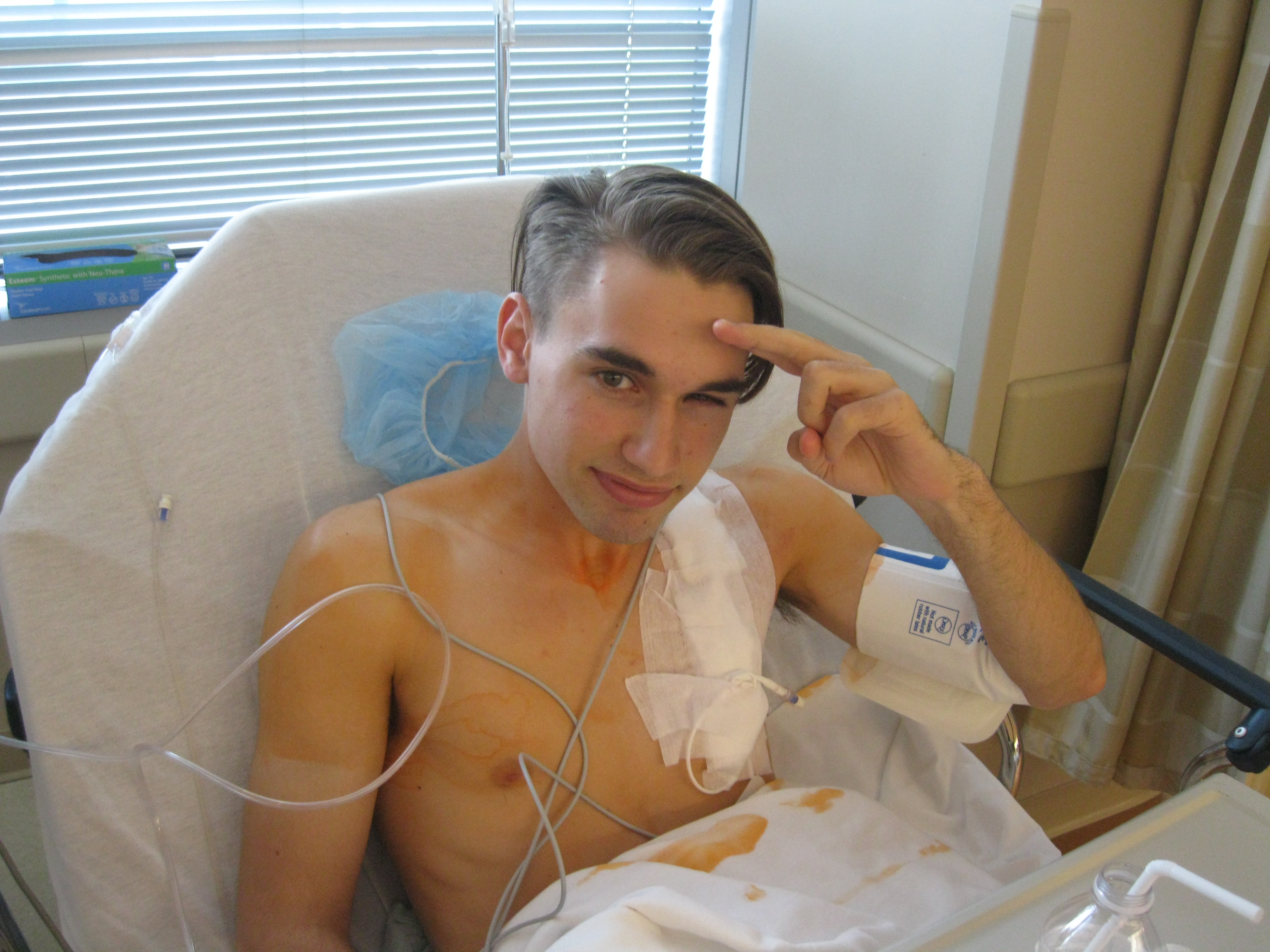
April 18, 2016 – Neil, outpatient, after completing surgery for installation of arterial catheter.


December, 2016 – Neil’s first in-patient hospitalization, head shaved for emergency shunt surgery, after neuro-radiologist assigned to his clinical trial case neglected timely notification of hydrocephalus evident in November 15 MRI (shown here with math teacher, SLTP colleague and Patriots fan, Chris Boie).